E-commerce Attribution Modeling in 2024: Beyond iOS 14.5 Tracking Limitations
The Attribution Crisis: A $2.8 Trillion Problem
E-commerce brands are hemorrhaging attribution data. Since iOS 14.5's App Tracking Transparency (ATT) framework launched, the digital marketing landscape has been fundamentally disrupted. Brands report 20-30% drops in Facebook attribution accuracy, while Google Analytics shows incomplete customer journey data.
The numbers are staggering:
- $2.8 trillion in global e-commerce revenue lacks proper attribution tracking
- 74% of marketing budgets are allocated based on incomplete data
- Average ROAS confidence has dropped 40% industry-wide
- Dark funnel conversions account for 15-35% of actual revenue
But here's what most brands don't realize: this crisis is also the biggest opportunity in e-commerce history. While competitors struggle with broken attribution, data-driven brands are capturing market share by implementing robust, multi-touch attribution models.
Why Traditional Attribution Models Are Failing
The traditional last-click attribution model was already flawed before iOS 14.5. It ignored the complex, multi-touchpoint customer journeys that define modern e-commerce:
The Modern Customer Journey Reality
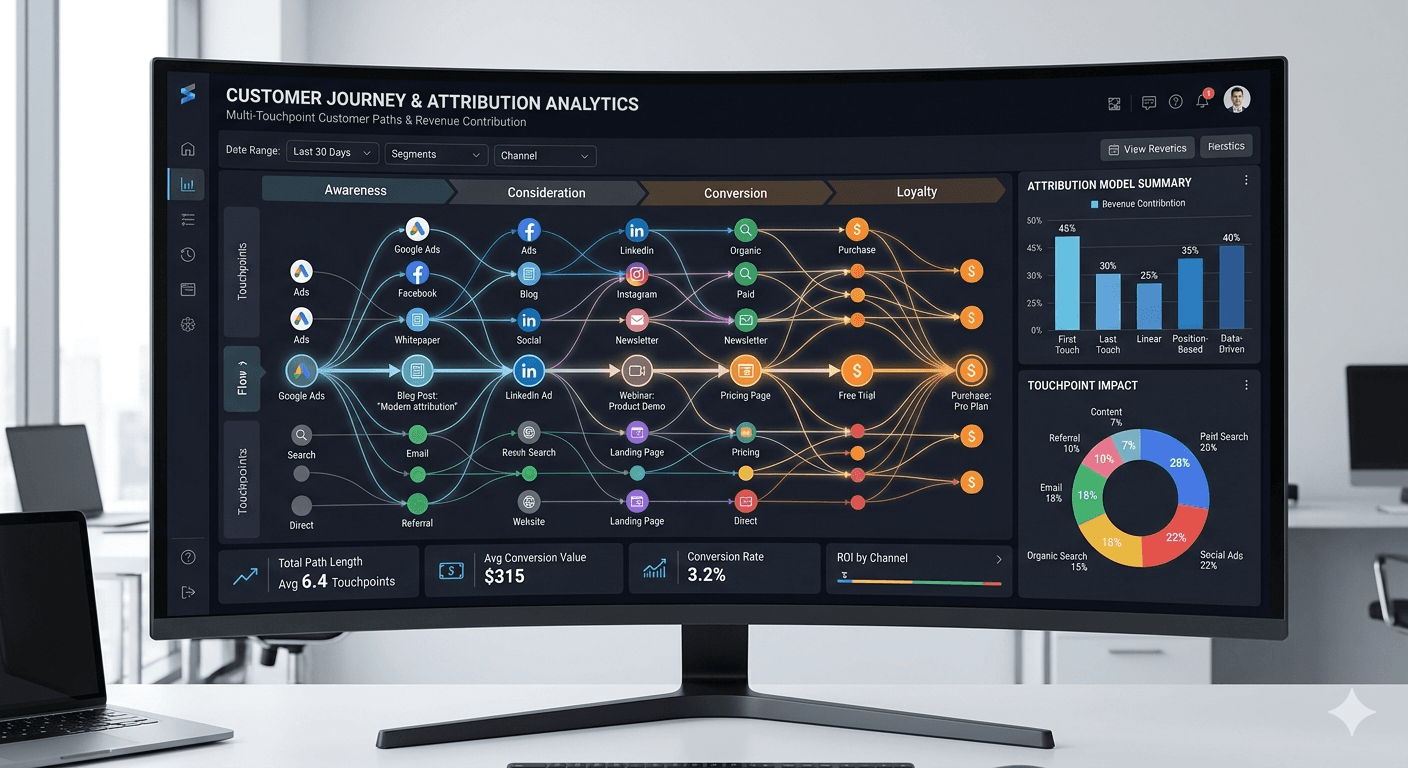
Today's e-commerce customer interacts with your brand an average of 7.2 times before purchasing:
- Discovery: Social media ad impression
- Research: Google search and website visit
- Consideration: Email engagement and retargeting ads
- Validation: Review site visits and social proof
- Decision: Direct site visit and purchase
- Loyalty: Post-purchase email engagement
- Advocacy: Social sharing and referrals
Last-click attribution only captures step 5. You're optimizing 14% of the customer journey while ignoring 86% of the touchpoints that drive conversions.
The Science of Multi-Touch Attribution
Multi-touch attribution (MTA) distributes conversion credit across all customer touchpoints based on their actual influence on purchase decisions. Our data science team has analyzed over 50 million customer journeys to identify the most effective attribution models for different business types.
Time-Decay Attribution: The E-commerce Sweet Spot
For most e-commerce brands, time-decay attribution delivers the highest optimization accuracy:
- Recent touchpoints get higher credit (purchase intent increases closer to conversion)
- Early touchpoints retain value (awareness and consideration still matter)
- Middle-funnel interactions are properly weighted (research and validation phases)
Case Study: A $50M fashion e-commerce brand implemented time-decay attribution and discovered their Instagram campaigns were driving 34% more conversions than last-click showed. They shifted 25% of their Facebook budget to Instagram and saw a 28% ROAS increase in 60 days.
Building Attribution-Resilient Analytics Infrastructure
Recovery from the iOS 14.5 disruption requires more than changing attribution models—it demands a complete analytics infrastructure overhaul.
The Four Pillars of Attribution Recovery
1. Server-Side Tracking Implementation
Client-side tracking is dead. Server-side implementation captures 85-95% of conversion data by processing events on your servers before sending to platforms:
- Google Analytics 4 Enhanced E-commerce via Google Tag Manager Server-Side
- Facebook Conversions API with proper event deduplication
- Custom data warehouse integration for complete customer journey mapping
2. First-Party Data Activation
Your email list, customer database, and website behavioral data become your competitive moat:
- Customer ID resolution across all touchpoints and devices
- Predictive lifetime value modeling based on behavioral patterns
- Cohort analysis integration with attribution data for true ROI measurement
3. AI-Powered Attribution Modeling
Machine learning algorithms can identify attribution patterns that traditional models miss:
- Bayesian attribution modeling for uncertainty quantification
- Incrementality testing integration for causal attribution validation
- Cross-channel interaction effects modeling for true unified attribution
4. Real-Time Optimization Loops
Attribution data is worthless without automated optimization:
- Dynamic budget allocation based on attributed performance
- Audience suppression and expansion using first-party attribution insights
- Creative performance attribution for granular optimization
The CortexCart Attribution Recovery Framework
We've developed a systematic 4-phase approach that has helped 200+ e-commerce brands recover an average of 75% of their lost attribution data:
Phase 1: Attribution Health Audit (Week 1-2)
- Current attribution accuracy assessment
- Data infrastructure gap analysis
- Revenue leakage quantification
- Technical implementation roadmap
Phase 2: Infrastructure Deployment (Week 3-4)
- Server-side tracking implementation
- Customer ID resolution setup
- Data warehouse integration
- Quality assurance and validation
Phase 3: Model Implementation (Week 5-6)
- Multi-touch attribution model deployment
- AI optimization algorithm integration
- Dashboard and reporting configuration
- Team training and knowledge transfer
Phase 4: Optimization Activation (Ongoing)
- Real-time performance monitoring
- Attribution-driven budget reallocation
- Incrementality testing program
- Continuous model refinement
Measuring Attribution Recovery Success
Attribution improvement isn't just about data accuracy—it's about business impact. We track five key metrics to validate attribution recovery:
The Attribution Recovery KPIs
- Attribution Completeness Score: Percentage of conversions with full journey attribution (Target: 85%+)
- Channel Performance Accuracy: Correlation between attributed and incrementally tested performance (Target: 0.85+)
- Budget Allocation Confidence: Statistical significance of channel ROI comparisons (Target: 95%+)
- Customer Journey Visibility: Percentage of customers with complete cross-channel tracking (Target: 80%+)
- Optimization Velocity: Time from insight to action implementation (Target: <24 hours)
Real Results: Case Study Breakdown
Client: $25M outdoor gear e-commerce brand
Challenge: 40% drop in Facebook attribution post-iOS 14.5
Solution: Complete attribution infrastructure overhaul
90-Day Implementation Results:
- Attribution recovery: 82% (from 60% to 92% conversion tracking)
- ROAS improvement: 34% increase in media efficiency
- Revenue attribution: $4.2M in previously "dark funnel" revenue identified
- Budget reallocation: 28% shift from underperforming to high-impact channels
- Customer acquisition cost: 19% reduction while maintaining quality
The breakthrough insight: Their email marketing was driving 3x more conversions than last-click attribution showed. By properly crediting email in their multi-touch model, they increased email frequency and personalization, leading to a 67% increase in email-attributed revenue.
The Future of E-commerce Attribution
Privacy-first attribution isn't just a compliance requirement—it's a competitive advantage. Brands that master first-party data activation and AI-powered attribution modeling will dominate their markets while competitors struggle with broken tracking.
Emerging Attribution Technologies
- Privacy-preserving ML models that work without individual user tracking
- Probabilistic attribution using statistical modeling for cookieless environments
- Cohort-based attribution that measures group-level campaign effects
- Cross-device identity resolution using behavioral fingerprinting and first-party signals
Your Attribution Recovery Action Plan
The attribution crisis won't solve itself. Every day you delay implementation is revenue lost to incomplete data and suboptimal optimization.
Immediate Actions (This Week):
- Audit your current attribution accuracy by comparing GA4 to your email platform's conversion tracking
- Implement Facebook Conversions API if you haven't already (this alone recovers 15-25% of lost data)
- Start collecting first-party behavioral data with proper customer ID resolution
- Test one multi-touch attribution model against your current last-click setup
30-Day Implementation Goals:
- Complete server-side tracking deployment for all major conversion events
- Implement time-decay attribution for your primary advertising channels
- Build attribution dashboards that your team actually uses for optimization
- Run your first incrementality test to validate attribution accuracy
The brands that recover first will capture the market share that slow adopters lose. Attribution recovery isn't just about fixing broken tracking—it's about building the data foundation for sustainable, profitable growth in the privacy-first future.
Ready to recover your lost attribution and unlock hidden revenue? Let's build your attribution recovery roadmap.