CortexCart Insight Dashboard vs. GA4: Which Tool Actually Drives Store Growth?
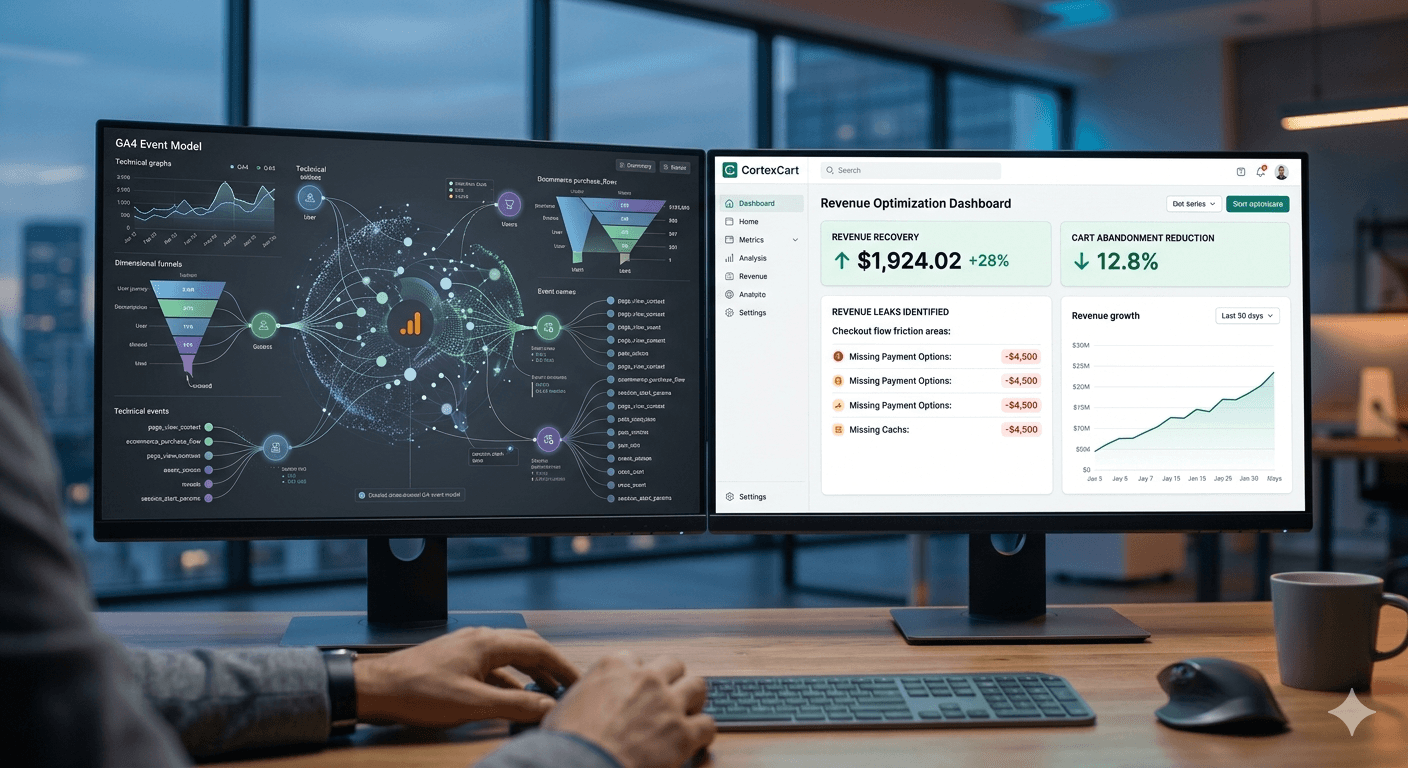
For modern e-commerce brands, data is never the bottleneck.
Between Shopify webhooks, ad network pixels, and email marketing metrics, merchants are virtually drowning in data. The real bottleneck is clarity. Most store owners don’t have a - traffic problem; they have a visibility problem.
For years, Google Analytics has been the default source of truth. However, the migration to - Google Analytics 4 (GA4) left many e-commerce operators in "spreadsheet hell"—spending hours pulling cross-channel CSVs just to understand basic performance. - Enter CortexCart Insight Dashboard, a purpose-built, AI-powered e-commerce growth platform native to AWS designed specifically to bridge this gap. -
This post provides an objective comparison of both tools to help you determine which belongs in your tech stack.
1. Data Paradigm: Event Tracking vs. Revenue Outcomes
The fundamental difference between GA4 and CortexCart lies in what they choose to measure and how they contextualize that data.
Google Analytics 4 (GA4) is built on a flexible, event-driven data model. Every interaction—a page view, a click, or a add-to-cart—is treated as an independent event. While highly customizable, GA4 is inherently general-purpose. It treats an e-commerce storefront with the same core logic as a B2B SaaS marketing site or a media blog.
CortexCart vs. GA4 Comparison
CortexCart Insight Dashboard is laser-focused exclusively on
e-commerce transaction economics and growth loops. Instead of making you map custom dimensions to see your net margins, CortexCart integrates directly with platforms like Shopify, WooCommerce, OpenCart, and your ad channels (Meta, Google, TikTok) to map the entire customer journey straight to business outcomes.
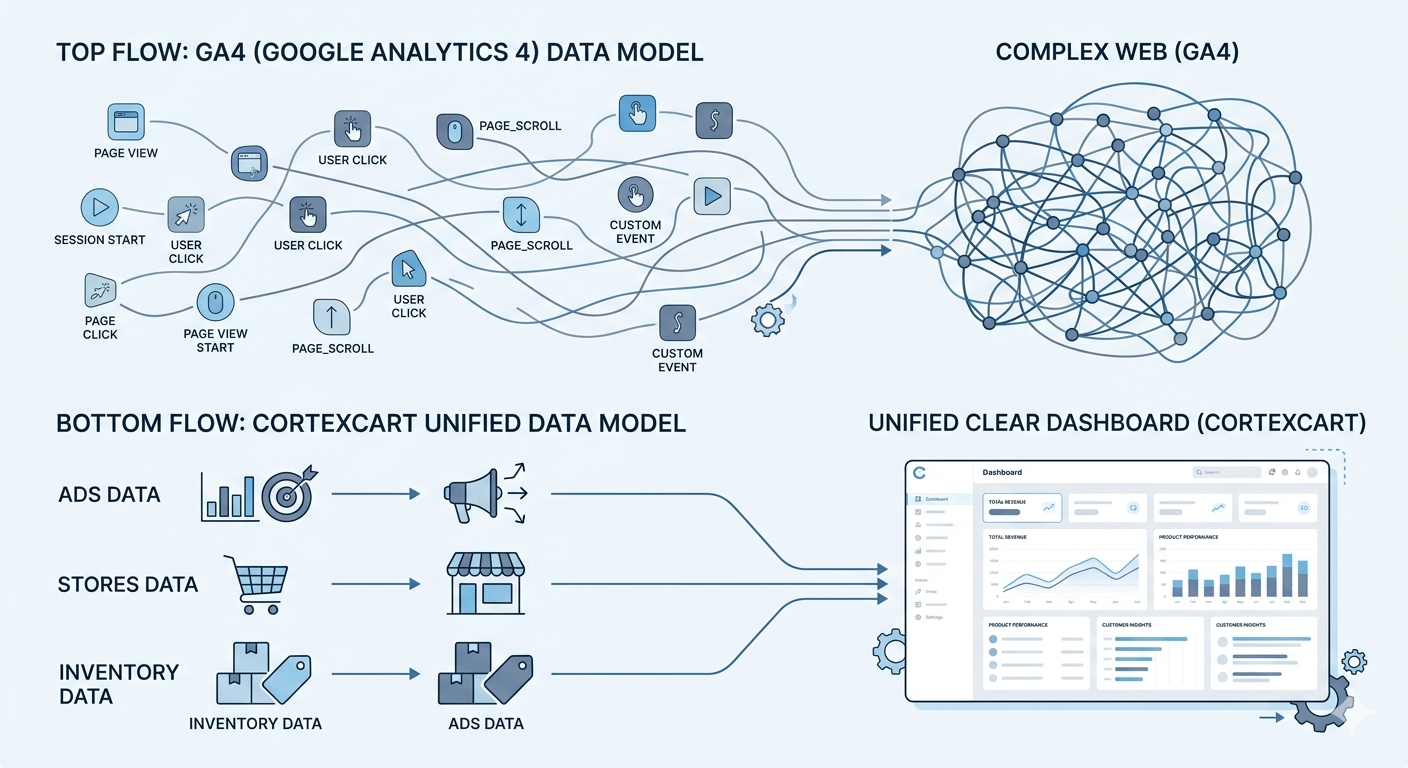 Infographic diagram mapping the difference between general-purpose web event tracking and integrated multichannel e-commerce revenue data flows. - Gemini AI Generated
2. Actionability: Raw Charts vs. AI Plain-English Diagnostics
Perhaps the most immediate operational difference is how both platforms present insights to the end user. GA4 provides powerful data compilation, but it acts primarily as a mirror: it shows you what happened, but leaves the "why" and "what to do next" entirely up to you.
To spot a drop-off in a checkout funnel, you must build custom exploration reports and run manual audits.
Conversely, CortexCart features a built-in AI Data Analyst agent. It doesn’t just render a line chart showing a dip in conversion rates; it actively runs ensemble machine learning algorithms to locate the precise "revenue leaks". For example, a dashboard alert might read: "Your checkout conversion from Meta traffic dropped 14% this week due to a shipping cost friction point on mobile devices; click here to see the recommended fix." It transforms raw analytics into direct plain-English optimization tasks.
3. Attribution & Cross-Channel Tracking
With multi-device journeys and privacy regulations tightening, attribution is a constant pain point for merchants.
GA4 Attribution: Relies heavily on data-driven attribution within the Google ecosystem. It is effective for web-based tracking but frequently suffers from blind spots when tracking off-site customer journeys across separate paid social channels, often resorting to standard last-click models that undervalue early funnel touchpoints.
CortexCart Multi-Touch Tracking: Employs native cross-channel touchpoint mapping and AI-driven attribution. By reconciling store backend order details with ad-network click data, it eliminates the "last-click bias," giving accurate ROI metrics across Facebook, Google, and TikTok simultaneously.
4. Technical Side-by-Side Comparison
Below is a direct feature comparison outlining where each tool shines:
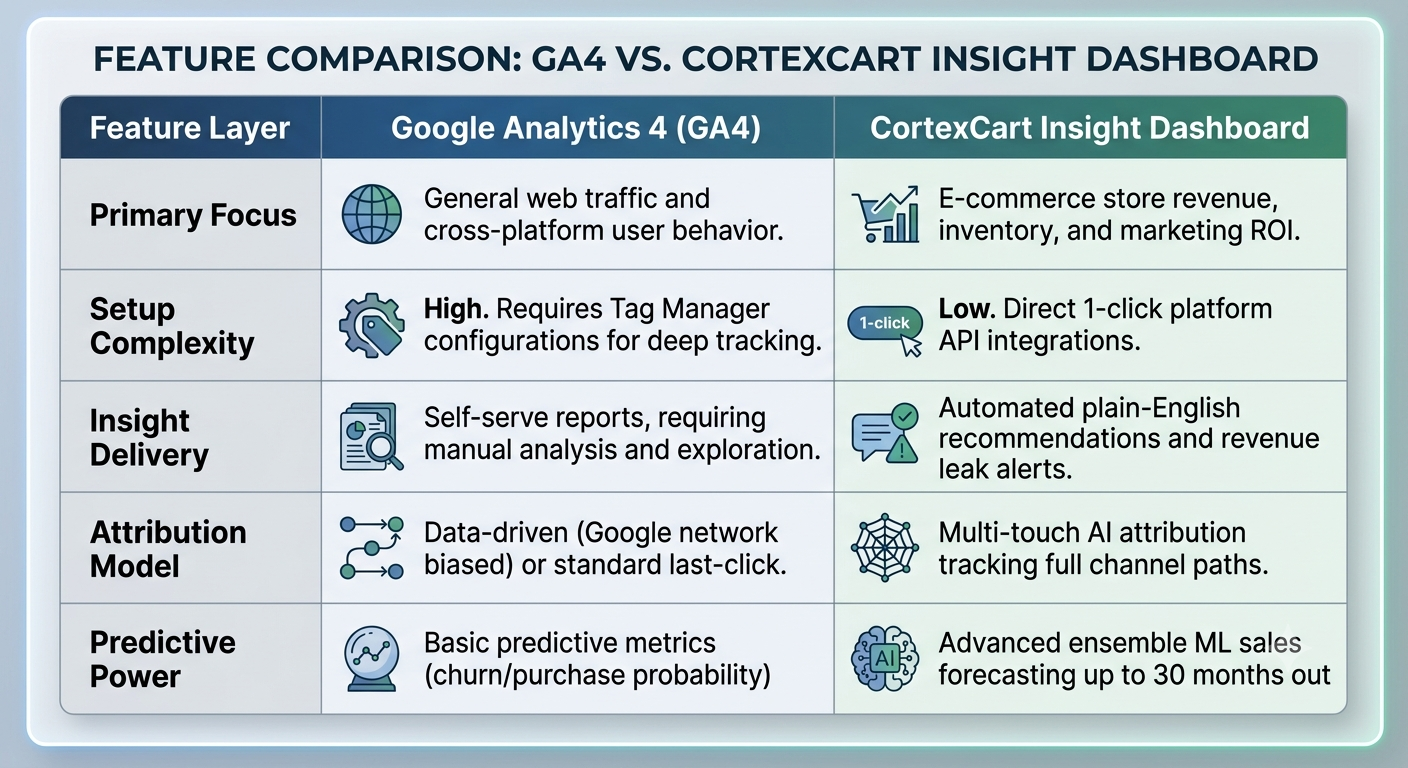 Comparative table showing details of features of Cortexcart & Google GA4 - Gemini AI Generated
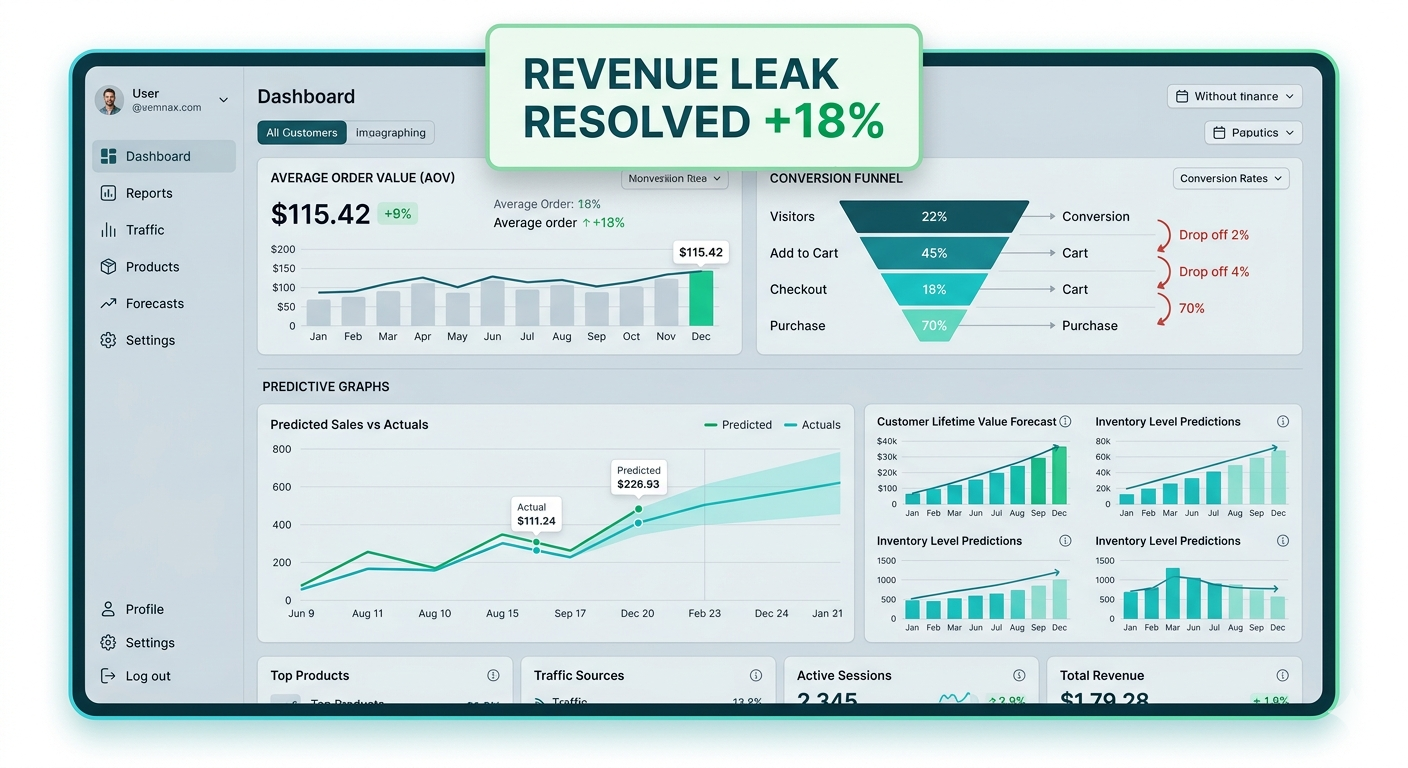 A clean user interface mockup illustrating an AI-driven e-commerce dashboard featuring predictive analytics and conversion optimization recommendations. - Gemini AI generated
The Verdict: Which Should You Use?
The choice between GA4 and CortexCart isn't necessarily an all-or-nothing proposition, as many high-growth brands run both simultaneously for different purposes.
Choose GA4 if: You are a seasoned enterprise analyst, have a dedicated data team, require deeply customized event setups for unique product setups, or manage a brand that relies heavily on content marketing alongside a standard checkout flow.
Choose CortexCart if: You are an ambitious e-commerce operator or merchant who wants to stop wrestling with spreadsheets. If you need immediate clarity on which ad campaigns are driving profitable sales, where your checkout funnel is losing money, and how to forecast inventory demand using automated machine learning, CortexCart is engineered directly for your operational workflow.
Core Takeaway for Store Operators
Google Analytics 4 tells you exactly what happened on your website. CortexCart tells you exactly how to fix your store, which specific channels earned your revenue, and what actions to take next to scale profit.
Book your free 15 minute consultation -> No obligation just a free report on where your data leaks may be reducing your revenue!
Related articles and further reading